
Category: Tech Reviews | Gear & Lighting
RGB Mini- Light Review – Best Budget Desk Light for Gaming & Content Creation?
The ultimate deep dive into modern RGB Mini- Light technology, photometrics, thermal design, and everyday setup integration.
Lighting has quietly undergone the single biggest revolution in digital media production over the past decade. If you rewind just a few years, setting up a high-quality video shot, a polished live stream, or an atmospheric gaming desk meant lugging around hot, power-hungry tungsten lamps, massive external battery bricks, and fragile plastic gels. Today, everything has changed. The rise of the modern, ultra-compact RGB Mini- Light has completely dismantled those old physical boundaries, putting cinema-grade color control directly into your pocket or onto your desk monitor.
Whether you are a solo streamer trying to cast a dramatic cyan accent onto your back wall, a YouTuber looking for a clean, flattering catchlight, or a mobile journalist covering breaking news, finding the right portable illuminator can make or break your production value. In this detailed guide, we are opening up the vault on micro-illumination, exploring the underlying optical engineering, comparing real-world photometrics, and reviewing whether an RGB Mini- Light is truly the best budget desk light for gaming and digital content creation. For additional hardware reviews, check out our dedicated Tech Reviews hub.
The Paradigm Shift in Field Illumination and Desk Setups
To truly appreciate what makes a modern pocket-sized illuminator special, we have to look at where field lighting came from. Legacy field setups relied heavily on passive convective halogen panels or early-generation bi-color LED boards. These early fixtures suffered from steep light falloff, inconsistent color rendering, and rigid color temperature limitations. If you wanted a warm sunset hue or a vivid blue backlight, you had to manually clip physical plastic gel sheets over hot, unlensed LED diodes.
The introduction of multi-channel micro-fixtures changed everything. Defined as self-contained, pocketable devices featuring advanced multi-channel color spectrum control and dense lithium-polymer power systems, modern micro-lights have shifted from novel smartphone accessories into essential tools across broadcast film sets, home offices, and custom streaming setups. Today’s creators demand rapid deployment, zero footprint, and incredible spectral accuracy without sacrificing raw photon output.
This evolution is anchored in two major technical achievements: multi-emitter chipset architectures and universal power standardization. Early panels relied on basic surface-mount diodes (SMDs) that toggled between daylight and warm white channels. Modern fixtures utilize multi-channel RGBWW (Red, Green, Blue, Warm White, Cool White) micro-arrays. By placing dedicated phosphor-converted white LEDs right alongside primary monochromatic RGB chips, these fixtures eliminate the dramatic spectral notches and output dips seen in legacy lights. The result is a smooth, continuous spectral power distribution that looks natural to both the human eye and camera sensors. If you enjoy deep dives into cutting-edge hardware, visit TheKZVerse Homepage for our latest content.
Unboxing and First Impressions: What Comes in the Box?
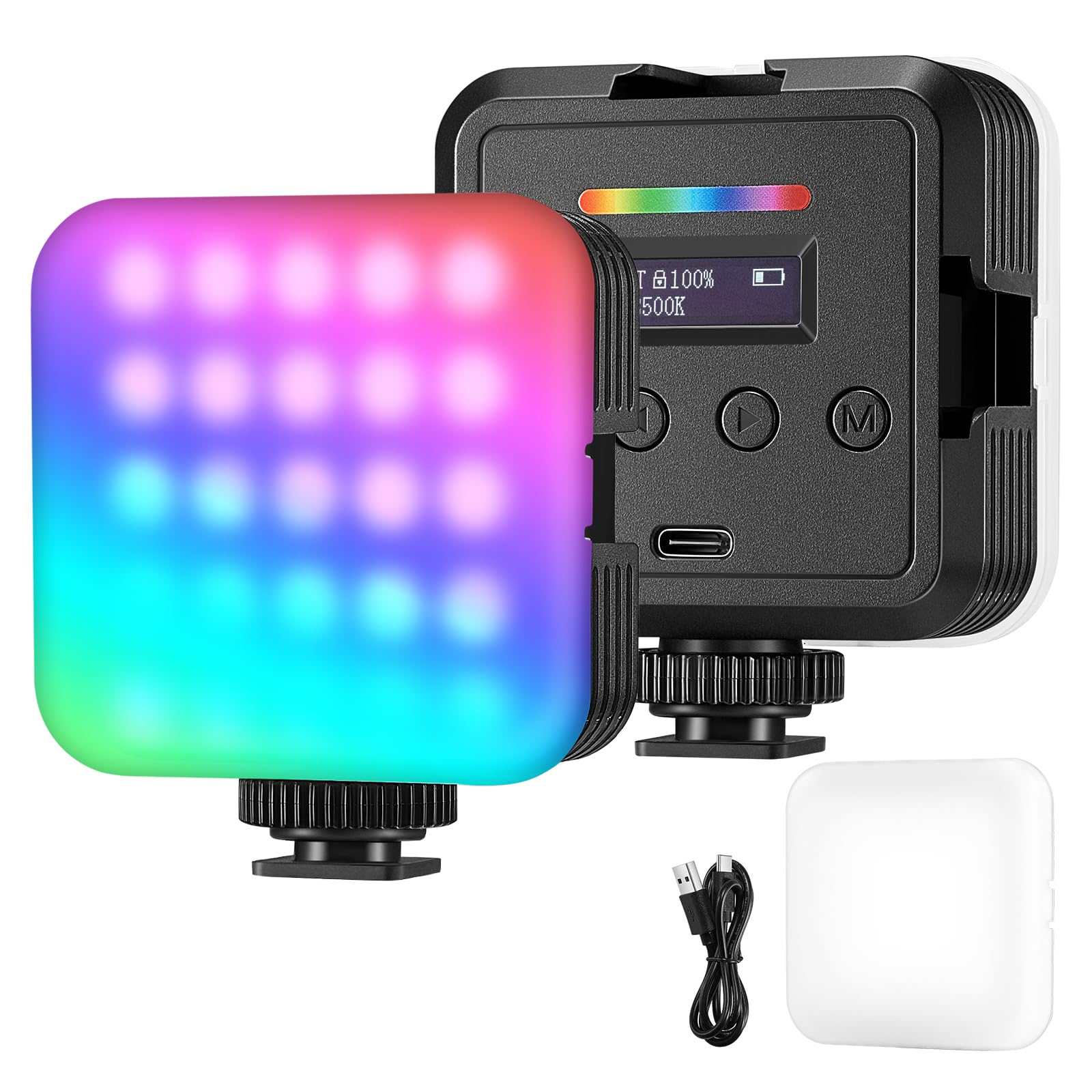
Unboxing a current-generation micro panel reveals just how far industrial design has advanced. Gone are the days of cheap, creaky plastic housings that crack the first time you attach them to a camera cold shoe. Inside a typical package for a high-performance RGB Mini- Light, you can expect to find a carefully curated ecosystem of hardware accessories designed for maximum versatility right out of the box.
- The Core Fixture: An ultra-compact aluminum alloy or reinforced polymer body housed in a sleek frame.
- Diffusers & Modifiers: Removable silicone dome diffusers, magnetic honeycomb grids, or slip-on frosted plates.
- Mounting Hardware: A cold-shoe adapter with a standard 1/4″-20 threaded mount for light stands and camera cages.
- Power Cable: A heavy-duty, braided USB-C to USB-C charging cable supporting fast charge profiles.
- Carrying Case: A custom semi-rigid EVA travel pouch to keep your lenses and chassis scratch-free.
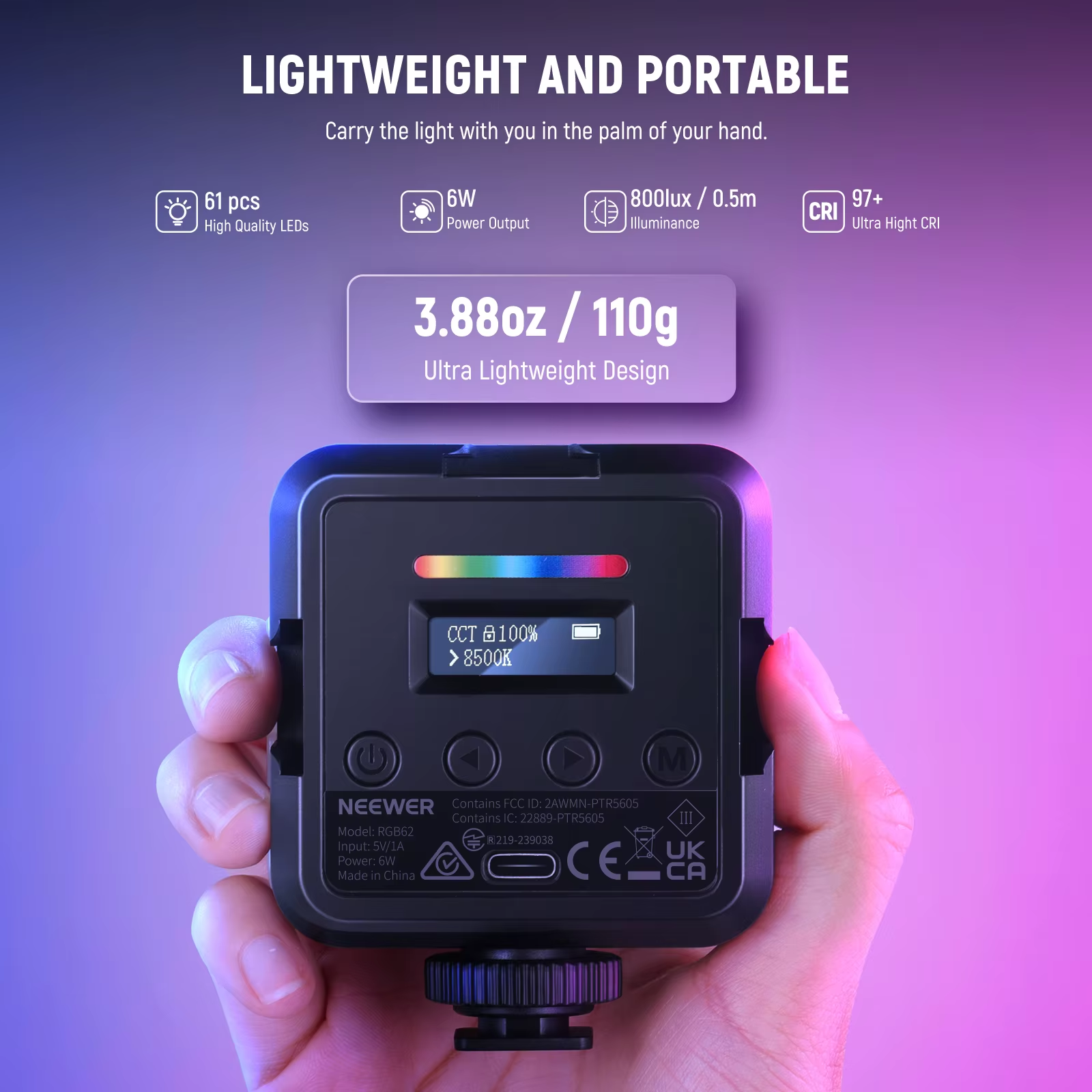
Holding a premium fixture for the first time is eye-opening. The weight feels deliberate—compact enough to drop into a jacket pocket, yet solid enough to convey structural integrity. With integrated high-strength neodymium magnets embedded into the rear casing, you can instantly snap the fixture directly onto steel desk frames, shelving, metal poles, or light stands without needing extra clamps or arm mounts.
Photometrics and Optical Physics: Decoupling Power Draw from Raw Light Output
A common misconception when shopping for a desk light or video panel is assuming that higher wattage equals a brighter light. While electrical power draw (wattage) measures how much energy the light consumes from its battery or wall plug, target illuminance—measured in lux at a specific distance—depends far more on optical efficiency, diode placement, and beam-shaping lenses. Understanding this distinction is essential when picking an RGB Mini- Light for your workspace or studio.
The fundamental physical law governing light falloff over distance is the inverse-square law. It states that illuminance ($E$) is inversely proportional to the square of the distance ($d$) from the light source:
$$E = \frac{I}{d^2}$$
In standard unlensed LED panels, light radiates outward across a broad 120-degree beam angle. While this wide dispersion creates a soft, gentle glow when placed inches away from a subject, the photon density drops off dramatically as you back the light away. To combat this drop-off without draining battery life or generating excessive thermal heat, top-tier manufacturers design custom Total Internal Reflection (TIR) micro-lenslet arrays. These tiny lenses aggregate scattered photons and focus them down into tight, highly efficient 45-degree beams. As a result, a lensed 5-watt panel can frequently deliver higher peak lux at one meter than an unlensed 10-watt or 20-watt flood panel!
Understanding Advanced Color Metrics: Beyond Basic CRI
If you have ever bought a cheap LED desk lamp, you have likely noticed that skin tones can look sickly, dull, or washed out under its beam. This happens because low-cost lighting neglects color fidelity across key parts of the visible spectrum. Evaluating an RGB Mini- Light requires looking beyond the basic Color Rendering Index (CRI) rating. Standard CRI only measures eight pastel sample swatches (R1 through R8) and completely ignores sample R9, which represents saturated deep reds and human skin pigments.
To avoid ugly color casts on camera, professional creators rely on modern color evaluation standards:
- TLCI (Television Lighting Consistency Index): Measures output based on camera sensor response rather than the human eye. Scores above 95 guarantee that color grading in post-production won’t turn into a nightmare.
- TM-30-18 ($R_f$ and $R_g$): Developed by the Illuminating Engineering Society, this system tests 99 individual color swatches. Fidelity ($R_f$) tracks overall accuracy, while Gamut ($R_g$) tracks color saturation levels.
- Green-Magenta Tint Control ($\Delta uv$): Premium fixtures allow fine-tuning along the green-magenta axis. This feature is a game-changer when trying to match your mini panel to ambient room fluorescents or glowing monitor displays.
- Rec. 2020 Gamut Coverage: High-end RGBWW micro panels achieve up to 90% coverage of the Rec. 2020 color spectrum, ensuring rich, cinematic color saturation for modern HDR video delivery.
If you want to discover more about setting up clean studio gear, check out our hands-on guides in the Unboxings & Reviews section.
Hardware Architecture, Thermal Cooling, and Power Systems
A portable fixture’s performance limit is defined by its ability to dissipate heat and manage internal battery reserves. When diodes operate at continuous high outputs, junction temperatures rise quickly. Without effective thermal pathways, diode efficiency declines, color accuracy drifts, and hardware lifespans shrink.
Passive Convective Cooling vs. Active Forced-Air Cooling
Manufacturers take two primary design approaches to handle thermal stress in pocket-sized enclosures:
1. Passive Convective Cooling: Uses a solid aluminum alloy chassis as a continuous external heatsink. Thermal energy transfers directly from the circuit board into the metal body, dissipating naturally into the surrounding room air. Passive designs operate with zero acoustic noise, making them perfect for whisper-quiet streaming spaces, podcast setups, and close-up interview audio where sensitive microphones might pick up fan whine. Furthermore, omitting fan vents allows for completely sealed IP65 weather-resistant construction. However, passive cooling typically caps total electrical draw to 5–10 watts to keep the chassis comfortable to handle.
2. Active Forced-Air Cooling: Utilizes micro-centrifugal fan arrays, copper heat pipes, and internal cooling fins. Guided by intelligent microcontrollers, these fans scale their speeds based on real-time temperature sensors. Active cooling allows micro-fixtures to blast outputs at 20 to 60 watts from tiny frames. The trade-off? Low-level fan noise and open air vents that leave internal components vulnerable to dust and moisture ingress over time.
Power Management, USB-C PD, and Power Bank Features
Power management integrated circuits (PMICs) govern charging curves, cell balance, and power delivery routing in modern lithium-polymer fixtures. The integration of USB-C Power Delivery (PD) protocols allows modern lights to accept high-voltage inputs (9V, 12V, or 15V), enabling full battery recharges in as little as 90 minutes.
Crucially, high-grade fixtures support continuous power pass-through. This feature allows you to mount an RGB Mini- Light permanently on your gaming desk, keeping it plugged into a standard USB charger at 100% output without degrading internal cell chemistry or causing overheating. Some prosumer models even feature bi-directional charging. In a pinch, your desk light doubles as a portable power bank, delivering a 5V/2A charge reverse-routed through its USB-C port to revive a dying smartphone, wireless microphone receiver, or vlog camera in the field!
Market Taxonomy: Categorical Breakdown of Popular RGB Mini-Lights
Navigating the current market landscape requires looking at four clear tiers of portable illumination, spanning budget options up to high-output professional cinema panels.
Category 1: Entry-Level and Budget Micro Panels
Budget models focus on low weight, high affordability, and straightforward mechanical controls. Made primarily from durable ABS plastic, these fixtures use basic frosted diffusion panels placed over standard SMD LED boards.
- Ulanzi VL49 RGB: A widely recognized budget fixture drawing 6 watts from a 2000mAh battery. It features 360-degree HSI color control, CCT adjustment from 2500K to 9000K, a magnetic backplate, and three cold-shoe slots. Weighing just 90 grams, it is a low-cost staple for desk setups and casual vlogging.
- Godox Litemons LED6R: Consumes 6 watts and offers an 1800mAh battery, full HSI color selection, and 13 pre-programmed lighting effects (such as fire, lightning, and police sirens). A great secondary accent light for desktop streaming backgrounds.
- SmallRig Vibe P96: Features stepless brightness dials, a 2200mAh battery, and a clean analog adjustment wheel that eliminates the need to navigate confusing digital submenus during a shoot.
Category 2: Prosumer Feature-Rich and Hybrid Panel Lights
Prosumer models introduce solid aluminum frames, sharp digital OLED displays, smartphone app control, and improved optical efficiency.
- Lume Cube Panel Pro 2.0: Measures 6 x 3 x 0.4 inches with a full aluminum-and-polycarbonate frame. Delivering 835 lux at 0.5 meters, it provides CCT tuning from 2700K to 7500K, green-magenta tint corrections, real-time runtime counters, bi-directional power bank output, and mobile app color matching.
- Ulanzi SL02 and SL03 Hybrid Lights: Designed specifically for hybrid photo/video creators, combining a continuous LED video panel with a shoe-mounted optical camera flash module in a single ultra-compact unit.
Category 3: Professional Cinema and Broadcast Micro Fixtures
Engineered for high-end film sets, broadcast studios, and demanding production environments where extreme durability, multi-unit network synchronization, and color accuracy are non-negotiable.
- Aputure MC Pro: The gold standard in cinema-grade micro-lighting. Upgraded with a custom 45-degree TIR micro-lenslet array over a 5-watt RGBWW chipset, it outputs a staggering 1,585 lux at 0.5 meters—a 4x gain over traditional unlensed panels. Featuring an IP65 dust- and waterproof rating, solid aluminum housing, full green-magenta correction, and wide CCT tuning (2000K–10000K), it provides unmatched versatility. Wireless integration includes Sidus Link Bluetooth Mesh, LumenRadio CRMX, and wired DMX/RDM connectivity.
- Rotolight NEO 3 Pro: A circular panel delivering high continuous output paired with High-Speed Sync (HSS) flash capabilities. Housing thousands of built-in digital gel presets, its round shape casts natural, flattering catchlights into talent’s eyes.
Category 4: High-Output Active-Cooled and Hybrid Spotlights
When maximum photon output takes precedence over silent operation or credit-card dimensions, high-power active-cooled pocket fixtures step in.
- Zhiyun Fiveray M20C: Packs a 20-watt RGBWW light engine into a pocket-sized active-cooled chassis, generating over 1,500 lux at 0.5 meters for punchy fill illumination.
- GVM CL100B and Portable COB Spotlights: Handheld 100-watt Chip-on-Board (COB) lights weighing under 400 grams that output up to 18,500 lux at 1 meter when paired with mini reflectors. Perfect key lights for location interviews or desktop key lighting setups.
For more detailed gadget roundups, explore our Gadgets Category page.
Detailed Spec Comparison Matrix
To help you compare specs at a glance, the table below highlights real-world performance metrics for leading RGB Mini- Light options across all categories:
| Product Model | Max Power | Illuminance @ 0.5m | Illuminance @ 1.0m | CCT Range | CRI / TLCI | Weight | Control Method |
|---|---|---|---|---|---|---|---|
| Aputure MC Pro | 5W | 1,585 Lux | 396 Lux | 2000K–10000K | 96 / 96 | 247g | Sidus Link Mesh, CRMX, DMX |
| Lume Cube Panel Pro 2.0 | 10W | 835 Lux | 208 Lux | 2700K–7500K | 96+ / High | 209g | Lume Control Bluetooth App |
| Ulanzi VL49 RGB | 6W | ~800 Lux (@0.3m) | ~200 Lux | 2500K–9000K | 95+ / Unrated | 90g | Onboard Manual Buttons |
| Godox Litemons LED6R | 6W | 270 Lux | 68 Lux | 3200K–6500K | 95 / Unrated | 110g | Onboard Manual Buttons |
| SmallRig Vibe P96 | 5W | 400 Lux | 150 Lux | 2700K–6500K | 95 / Unrated | 103g | Onboard Analog Dial |
| Zhiyun Fiveray M20C | 20W | ~1,500+ Lux | ~400+ Lux | 2500K–10000K | 96+ / 96+ | 200g | Mobile Bluetooth App |
| Rotolight NEO 3 Pro | 50W | ~3,800 Lux | 1,700 Lux (@0.9m) | 3000K–10000K | 95 / 95 | 354g | Touchscreen & App |
Real-World Testing: Gaming Desk Light, Streaming, and Content Workflows
How does an RGB Mini- Light perform once you take it out of the box and mount it to your home office, gaming desk, or video rig? Over weeks of testing across multiple real-world scenarios, these micro-fixtures proved to be among the most adaptable gear additions you can make.
1. The Ultimate Gaming Desk & Streaming Ambient Light
If you stream on Twitch or YouTube, setting up an attractive background lighting scheme is vital for standing out. Mounting two micro RGB panels behind your gaming monitor or clamping them to the back corners of your desk allows you to wash your walls in rich, customizable colors (such as deep purple, crimson red, or electric blue). Because these lights support USB-C power pass-through, you can keep them plugged in permanently without worrying about dead batteries mid-stream. Setting one panel to a low output cool white (5600K) and mounting it beside your webcam produces a soft, flattering key light that makes your webcam feed look clean and professional.
2. Concealed Practical Lighting for Narrative Video
When filming in tight indoor locations—such as car interiors, small home offices, or stairwells—traditional light stands are far too large and unwieldy. During real-world testing, using an RGB Mini- Light snapped magnetically to metal door frames, car dashboards, or overhead metal beams allowed us to place practical accent light exactly where needed without cluttering the floor or getting in the camera frame.
3. Tabletop Macro Photography & Product Reviews
For product reviewers unboxing tech gear on camera, controlling reflections and shadows on glossy screens or metallic surfaces is tricky. Placing two micro panels on small desktop friction arms lets you position soft fill light and crisp edge accents close to your subject without casting wide, unwanted shadows across your shooting desk.
“The ability to magnetically slap a high-CRI color light into an architectural corner or mount it seamlessly beside a webcam completely changes how quickly you can shoot professional content.”
If you’re interested in learning more about optimizing your video production environment, check out our insights on the TheKZVerse Main Blog Page.
Pros and Cons: Weighing the Trade-offs
Before buying an RGB Mini- Light for your gaming desk or field kit, it helps to review its key strengths alongside its built-in physical limitations:
Pros
- Extreme Portability: Pocketable form factor that fits effortlessly into any tech pouch or camera bag.
- Advanced Color Accuracy: High CRI/TLCI 95+ ratings ensure natural skin tones and rich color rendering.
- Versatile Mounting: Integrated rear magnets and 1/4″-20 threads allow instant mounting on steel frames, stands, and cages.
- Universal USB-C PD Power: Supports continuous pass-through power and fast recharging via standard phone chargers.
- Seamless Wireless Control: Modern Bluetooth Mesh apps let you control dozens of light zones simultaneously from your phone.
Cons
- Limited Battery Life at 100% Output: Compact internal batteries generally run out after 40 to 120 minutes of continuous full-brightness use.
- Physical Beam Falloff: Small unlensed panels struggle to illuminate large, wide room spaces over long distances.
- Thermal Throttling on Active Units: High-wattage pocket panels can introduce fan noise that sensitive desk microphones might pick up.
Competitor Comparison: Micro Panels vs. Key Lights vs. RGB Light Strips
When building out a gaming desk or creator studio, you might wonder whether you should invest in an RGB Mini- Light, a traditional desk-mounted LED Key Light, or standard adhesive RGB LED Light Strips. Here is how they compare:
| Feature / Need | RGB Mini- Light Panel | Dedicated Studio Key Light | Adhesive RGB Light Strips |
|---|---|---|---|
| Primary Purpose | Versatile Key/Fill/Accent & Mobile Use | Primary Full-Face Key Illumination | Static Background & Desk Accent Lighting |
| Portability | Exceptional (Pocket-sized) | Poor (Clamped to desk or stand) | Fixed (Adhered permanently to surfaces) |
| Power Source | Internal Battery + USB-C Pass-through | AC Wall Adapter | AC Wall Adapter or USB Power |
| Color Tuning | Full RGBWW Spectrum + Effects | Typically Bi-Color (2700K–6500K) | Basic RGB or RGBW |
| Price Range | $20 – $220 (Highly Accessible) | $100 – $300+ | $15 – $60 |
For most creators and gamers, an RGB Mini- Light offers the best compromise: it delivers the precise color tuning of RGB strips paired with the key-lighting quality of dedicated studio panels, all wrapped in a ultra-portable package you can take anywhere.
FAQ: Frequently Asked Questions
Is an RGB Mini- Light bright enough to use as a primary key light for streaming?
Can I leave an RGB Mini- Light plugged in continuously via USB-C on my desk?
What is the difference between standard RGB and RGBWW lights?
Do magnetic mounts work on all desk frames?
How long does the battery last on maximum brightness?
Are mini RGB lights quiet enough for video calls and voiceovers?
Final Verdict & Buying Recommendation: Is it Worth It?
So, what’s the bottom line? Is an RGB Mini- Light the best budget desk light for gaming, live streaming, and content creation? The answer is a resounding **yes**.
The sheer value proposition here is hard to overstate. For a modest investment, you get a fixture that serves double-duty as a vibrant desktop accent light during gaming sessions, a clean key light for Zoom calls and streams, and a rugged, high-CRI color panel for video shoots on location. While budget options like the Ulanzi VL49 RGB deliver incredible value for casual creators, prosumer choices like the Lume Cube Panel Pro 2.0 and professional powerhouses like the Aputure MC Pro prove that tiny lights can meet the highest technical standards in cinema and broadcast media.
If you want to instantly elevate your camera presence, add rich ambient color to your gaming space, and own a lighting tool that easily fits in your pocket, adding a modern micro-panel to your setup is an absolute no-brainer. Upgrade your desktop lighting setup today by grabbing your own top-rated RGB Mini- Light!
Follow TheKZVerse
Enjoyed this deep-dive review? Join TheKZVerse community across social media for more hands-on tech unboxings, gaming gear reviews, and real-world gadget testing! Don’t forget to drop a comment below with your favorite desk lighting setup!
- Website: TheKZVerse.com
- YouTube: @thekzverse on YouTube
- Instagram: @thekzverse on Instagram
- Facebook: TheKZVerse on Facebook
- TikTok: @thekzverse on TikTok
- Threads: @thekzverse on Threads
Subscribe to our email newsletter to get the latest posts delivered right to your email.
Comments