
Category: Tech Reviews | Gadgets
The Ultimate NEEWAR Car Clamp Review: Comprehensive Analysis & Buyer Guide to Neewer Automotive Mount Systems
Testing the popular NEEWAR Car Clamp lineup—putting Neewer’s suction cups, active vacuum pumps, and extension poles through real-world dynamic load tests.
Automotive content creation, high-speed tracking shots, and immersive point-of-view (POV) driving clips have become foundational elements of modern digital video production. Whether you are capturing cinematic rolling shots for automotive reviews, recording rugged off-road trail adventures, or creating daily interior vlogs, securing camera gear onto moving vehicles presents major mechanical challenges. Filmmakers and tech enthusiasts frequently search online for the popular NEEWAR Car Clamp to find high-performance, cost-effective vehicle mounting solutions.
On search engines, consumer forums, and retail platforms, “NEEWAR” is a widespread phonetic misspelling of Neewer, a prominent global manufacturer of photographic accessories, studio lighting, and camera support hardware. While the phrase “car clamp” historically described physical anti-theft wheel locks designed to immobilize vehicles, in the context of videography and modern content creation here at TheKZVerse Homepage, it refers specifically to Neewer’s specialized camera mounting systems. These systems combine heavy-duty suction pads, articulated magic arm clamps, NATO rail quick-release mechanisms, and extension poles to anchor action cameras, smartphones, and mirrorless rigs onto vehicle exteriors and interiors.
In this comprehensive research report and hands-on review, we will provide an exhaustive analysis of Neewer’s automotive camera mounting ecosystem. We will examine the mechanical engineering, kinetic load physics, lineup specifications, real-world community feedback, and operational safety protocols across flagship models, including the CA065, CA136, CA166, CA013, CA104/CA105, and CA158. If you enjoy exploring cool gear breakdowns like this, be sure to check out our Unboxings Category for more deep dives.
Decoding the Search: NEEWAR Car Clamp and Market Context
Understanding why search volume clusters around the phrase NEEWAR Car Clamp requires dissecting both consumer terminology and brand positioning within the photo and video industry. Neewer has established a massive global footprint across e-commerce marketplaces like Amazon, B&H Photo, and Best Buy by delivering feature-rich production hardware at highly accessible price points. Because the brand name is non-English in origin and phonetically pronounced as “New-er,” consumer search queries regularly generate variations such as “NEEWAR,” “Neewar,” or “Newer.”
Simultaneously, the word “clamp” is used broadly by videographers to describe any mechanical mounting fixture that firmly grips or anchors a camera rig. Neewer’s vehicle mounting kits rely heavily on specialized clamping hardware—specifically articulated magic arm clamps, oval extension pole clamps, and quick-release NATO bar clamps. Consequently, web searches combining “NEEWAR” and “Car Clamp” represent creators seeking Neewer’s suction-based automotive camera mounts and articulated arm clamps.
The surge in demand for these vehicle mounting solutions is driven directly by the rapid evolution of action cameras and 360-degree imaging hardware. Devices such as the GoPro Hero 13, Insta360 X4, and DJI Osmo Action 5 Pro allow creators to capture ultra-high-definition, stabilized footage from extreme perspectives. However, achieving dynamic angles—such as low-slung wheel shots, bonnet POV angles, or floating third-person tracking shots—requires mounting gear externally onto car hoods, windshields, side doors, and panoramic glass roofs. Neewer’s car mounting systems have emerged as a dominant choice for creators balancing structural reliability with budget efficiency. For more coverage on action camera rigs, visit our Gadgets Section.
Engineering Principles and Structural Architecture
Capturing professional cinema footage from a vehicle in motion subjects mounting hardware to extreme multi-axis stress. Vehicle mounts must continuously counteract gravitational pull, road-induced shock and vibration, acoustic turbulence, and multi-directional wind shear forces. The NEEWAR Car Clamp addresses these physical demands through three core structural engineering principles: triangular load distribution, dual-type vacuum suction mechanisms, and modular clamping interfaces.
Triangular Suction Footprint and Load Distribution
Single suction cup mounts, regardless of diameter, suffer from a fundamental mechanical vulnerability: susceptibility to rotational twisting moments and localized seal shear when subjected to sudden lateral vehicle maneuvers. To eliminate rotational play and isolate camera movement, Neewer’s flagship car mounting kits—such as the CA065, CA136, and CA166—utilize a three-point triangular footprint.
By distributing the camera payload across three independent rubber suction cups arranged in a tripod geometry, the mounting rig converts shear forces into balanced compressive and tensile loads. If micro-vibrations or surface irregularities momentarily weaken the atmospheric seal on one suction cup, the remaining two cups maintain structural adhesion to the car body panel, providing crucial redundancy that prevents total rig detachment. This design approach is similar to professional cinema rigs we cover in our Tech Reviews Category.
Suction Actuation Mechanics: Lever-Lock vs. Active Vacuum Pump
Neewer implements two distinct suction actuation technologies across its vehicle product catalog, catering to different payload weight classes and operational environments:
- Lever-Actuated Mechanical Cups: Featured on consumer-grade models like the CA065, these 3-inch (74mm) silicone-rubber cups utilize a spring-loaded center button combined with a mechanical lock lever. Pressing the central button flattens the cup face against the vehicle surface to displace ambient air, while pulling down the locking lever pulls the cup’s center upward, creating a sealed internal low-pressure vacuum pocket.
- Active Piston Vacuum Pump Cups: Featured on professional-tier mounts like the CA136, CA013, and CA104/CA105 series, these industrial-grade cups utilize a manual piston plunger built into the mount housing. Depressing the pump plunger repeatedly evacuates air from beneath the high-grade rubber pad through a one-way check valve. This active evacuation process generates higher atmospheric vacuum pressure, achieving superior hold capacities suitable for heavier camera bodies and high-speed driving conditions.
Articulated Clamping Arms and NATO Rail Integration
The versatility of the NEEWAR Car Clamp ecosystem stems from its modular clamping architecture. The magic arm assemblies utilize dual 360-degree rotatable stainless-steel ball heads anchored within a central aluminum friction clamp. Tightening a single central wingnut compresses both ball sockets simultaneously, locking the articulating arm firmly into position.
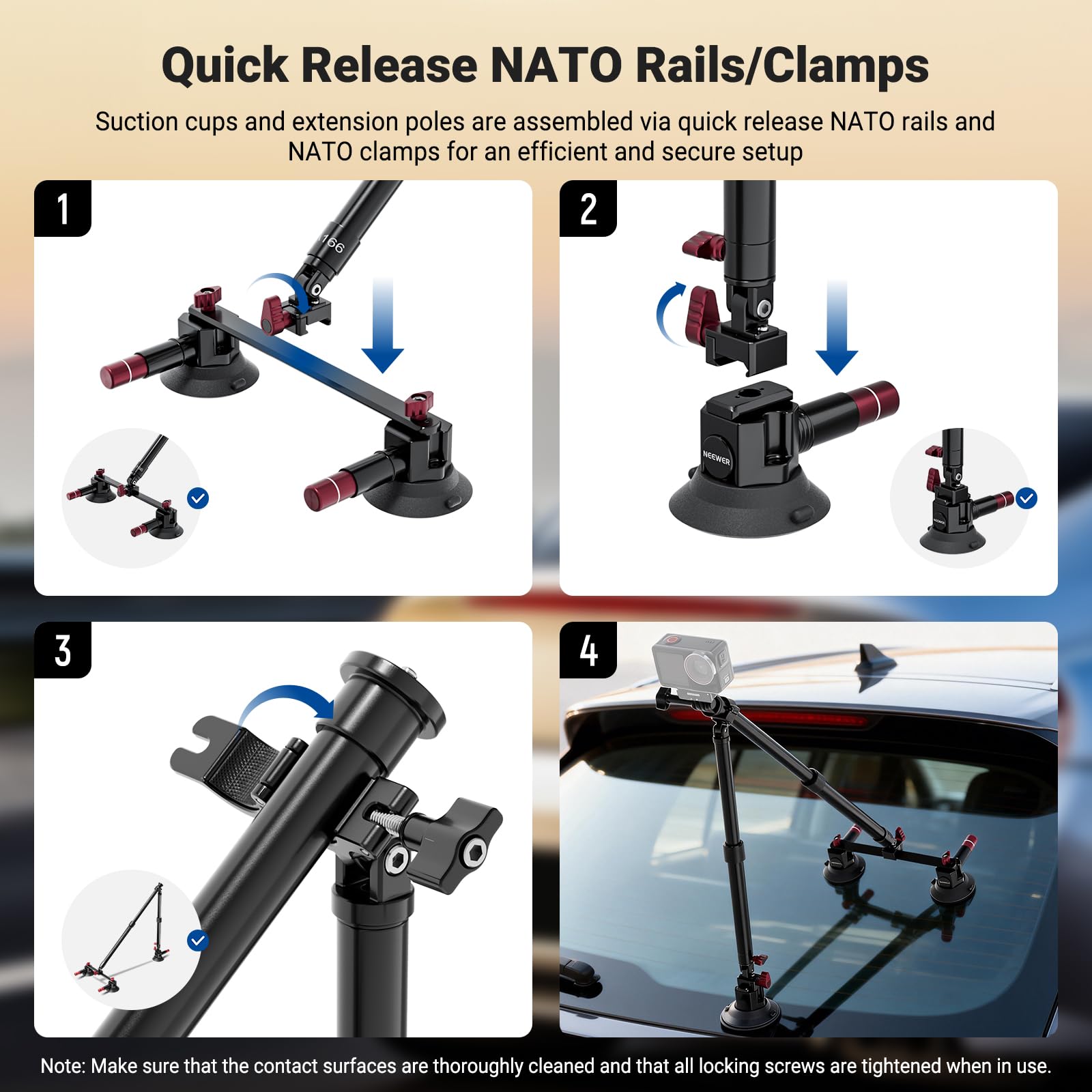
In advanced models like the CA136 and CA166, Neewer replaces fixed screw plates with quick-release NATO rails and NATO clamps. Originally designed for military weapons hardware, NATO rails feature standardized bevels that allow magic arms and extension poles to slide laterally along the rail before locking down via a quick-release lever. This allows filmmakers to make fine lateral adjustments to camera positioning without unseating the suction cups from the car paintwork. To check current pricing on these setups, view the Neewer Car Mount options on Amazon.
Detailed Breakdown of Flagship Neewer Car Mount Models
Neewer produces a diverse catalog of vehicle mounts tailored to specific camera payloads, vehicle mounting locations, and content creation workflows. Below is a detailed breakdown of the primary models that make up the NEEWAR Car Clamp search ecosystem.
Neewer CA065 Triple Suction Cup Car Mount Kit
The Neewer CA065 (SKU 66605047) is the most widely searched and purchased model in Neewer’s automotive lineup. Engineered primarily for action cameras, mirrorless vlogging setups, and smartphones, the CA065 combines a dual-cup base unit with a standalone single suction cup to form an adaptable three-point support system.
The structural foundation consists of two 3-inch (74mm) suction cups connected by an arched aluminum U-bracket, working alongside an independent 3-inch suction cup. The kit features a 4-section aluminum telescopic extension pole that extends from a collapsed length of 12.6 inches (32cm) out to 43.3 inches (110cm). This pole connects to the single suction cup via a 1/4″-20 threaded screw and is locked into the magic arm using a 0.95-inch (24mm) maximum-adjustable oval pipe clamp.
The magic arm incorporates dual 360-degree ball heads, providing fluid angle adjustments. In terms of load capacity, the CA065 supports up to 11 lbs (5 kg) when used in a compact, unextended orientation. However, when the telescopic extension pole is deployed to its maximum length of 43.3 inches, the dynamic weight capacity scales down to 2.2 lbs (1 kg) to compensate for extended rotational torque. The complete kit weighs approximately 2.4 lbs (1.1 kg) and ships with a universal action camera adapter, short extension pole, safety lanyard, and hex keys.
Neewer CA136 Carbon Fiber Triple Suction Mount Kit
Representing a premium, carbon-fiber evolution of the triple suction platform, the Neewer CA136 (SKU 66606648) targets professional automotive filmmakers. The CA136 replaces aluminum extension components with high-rigidity 24-inch (60cm) carbon fiber poles. Carbon fiber provides superior structural stiffness while reducing overall rig weight, minimizing high-frequency road vibrations transmitted to the camera sensor.
Unlike the CA065’s arched screw bracket, the CA136 integrates flat NATO rails connecting the suction bases. Quick-release NATO clamps assemble the entire structure, allowing rapid setup, teardown, and lateral positioning adjustments. Additionally, the CA136 utilizes manual piston vacuum pumps equipped with built-in safety indicator lines that provide immediate visual confirmation of vacuum pressure. The kit supports a dynamic payload capacity of 2.2 lbs (1 kg) at maximum extension and is fully compatible with GoPro Hero 13/12/11, Insta360 X4/X3/X2, and DJI Osmo Action series cameras.
Neewer CA166 Triple Suction Cup Basics Kit
Positioned as a bridge between the consumer CA065 and the premium CA136, the Neewer CA166 Basics Kit (SKU 66608798) delivers NATO rail modularity at a budget-conscious price point. It features three lever-actuated 3-inch suction cups, an all-aluminum alloy frame, a 24-inch (60cm) extension pole, and quick-release NATO clamps. It maintains a 2.2 lb (1 kg) payload capacity, providing high structural rigidity for action camera rigs.
Neewer CA013 6-Inch Heavy-Duty Camera Vacuum Mount
For filmmakers mounting full-sized mirrorless cameras, cinema bodies, or heavy vlogging setups directly to car hoods or side doors, the Neewer CA013 (SKU 66602539) relies on raw surface area and active vacuum displacement. The CA013 features a single 6-inch (152mm) industrial silicone rubber suction cup driven by a heavy-duty piston pump.
The sheer size of the 6-inch suction surface delivers extraordinary holding power: in static conditions, it holds up to 132 lbs (60 kg) horizontally and 110 lbs (50 kg) vertically. Under dynamic driving conditions on smooth roads at speeds up to 80 km/h (50 mph), it safely carries a dynamic camera payload of up to 6.6 lbs (3 kg). The CA013 includes an articulated aluminum magic arm equipped with dual 1/4″-20 swivel ball heads alongside interchangeable 1/4″-20 and 3/8″-16 screw adapters, allowing direct attachment to camera cages or fluid heads.
Neewer CA104 and CA105 Compact Vacuum Mounts
Designed for minimalist, single-point mounting, the Neewer CA104 (3-inch / 76mm cup) and CA105 (4.5-inch / 120mm cup) are compact vacuum pump mounts. Constructed from CNC-machined aluminum alloy, these mounts feature dual ball head magic arms and ARRI anti-rotation locating holes alongside standard 1/4″-20 and 3/8″-16 mounting points.
The CA104 weighs 9.3 oz (264g) and supports a dynamic driving payload of 4.4 lbs (2 kg) at speeds up to 80 km/h, with a static hold rating of 44 lbs (20 kg) horizontally. The larger CA105 weighs 16.9 oz (480g) and increases dynamic capacity to 6.6 lbs (3 kg) and static capacity to 66 lbs (30 kg). Both units ship with an action camera adapter and an adjustable smartphone clamp.
Neewer CA158 Suction Cup Phone & Camera Mount Kit
Targeted at mobile content creators and entry-level vloggers, the Neewer CA158 (SKU 66608655) utilizes a high-strength ABS plastic and aluminum hybrid structure. It incorporates a one-button press suction cup mechanism, an articulated dual-ball magic arm, a 1/4″-20 thread, a three-prong action camera adapter, and a phone clamp accommodating devices between 2.44 inches and 5.31 inches (62mm to 135mm) wide. It provides stable mounting for smartphone vlogging, GPS navigation, and light action recording.
Technical Specifications Matrix
The comparison table below provides a direct specification matrix across Neewer’s primary vehicle mounting products within the NEEWAR Car Clamp family:
| Model & SKU | Mounting Mechanism | Construction Materials | Cup Diameter / Quantity | Dynamic Load Rating (In Motion) | Static Hold Rating (Stationary) | Extension System | Max Speed Limit | Typical Retail Price |
|---|---|---|---|---|---|---|---|---|
| CA065 (66605047) | Lever-Lock / Push Button | Aluminum Alloy & Rubber | 3x 3.0″ (74mm) | 2.2 lbs (1.0 kg) extended | 11.0 lbs (5.0 kg) compact | 12.6″ to 43.3″ Aluminum Pole | 80 km/h (50 mph) | $89.99 – $119.00 |
| CA136 (66606648) | Active Piston Vacuum Pump | Carbon Fiber & Aluminum | 3x 3.0″ (74mm) | 2.2 lbs (1.0 kg) | ~11.0 lbs (5.0 kg) | 24.0″ Carbon Fiber Pole | 80 km/h (50 mph) | $114.99 – $139.99 |
| CA166 (66608798) | Lever-Lock Suction | Aluminum Alloy | 3x 3.0″ (74mm) | 2.2 lbs (1.0 kg) | ~11.0 lbs (5.0 kg) | 24.0″ Aluminum Pole | 80 km/h (50 mph) | $95.99 – $109.99 |
| CA013 (66602539) | Active Piston Vacuum Pump | Aluminum Alloy & Silicone | 1x 6.0″ (152mm) | 6.6 lbs (3.0 kg) | 132 lbs Horiz. / 110 lbs Vert. | N/A (Magic Arm) | 80 km/h (50 mph) | $49.99 |
| CA104 (66605559) | Active Piston Vacuum Pump | CNC Aluminum & Rubber | 1x 3.0″ (76mm) | 4.4 lbs (2.0 kg) | 44 lbs Horiz. / 26.5 lbs Vert. | N/A (Magic Arm) | 80 km/h (50 mph) | $37.99 – $39.99 |
| CA105 (66605559) | Active Piston Vacuum Pump | CNC Aluminum & Rubber | 1x 4.5″ (120mm) | 6.6 lbs (3.0 kg) | 66 lbs Horiz. / 30 lbs Vert. | N/A (Magic Arm) | 80 km/h (50 mph) | $47.99 |
| CA158 (66608655) | One-Button Lever Suction | ABS Plastic & Aluminum | 1x Standard Cup | ~2.2 lbs (1.0 kg) | Standard Mobile Rating | N/A (Phone Clamp) | Controlled Speeds | $25.99 – $30.99 |
Explore Neewer Car Mounts on Amazon
Aerodynamic Physics, Lever Torque, and Safety Protocols
Deploying external camera gear on moving vehicles requires a basic understanding of fluid dynamics, mechanical leverage, and safety engineering. Failure to account for speed-dependent forces can result in structural failure, property damage, or traffic hazards.
Dynamic Drag Forces and Speed Exponentiality
When a vehicle moves forward, air resistance exerts continuous aerodynamic drag against the external camera rig. Aerodynamic drag force increases exponentially relative to vehicle velocity. Doubling vehicle speed from 40 km/h (25 mph) to 80 km/h (50 mph) increases the aerodynamic drag force acting on the camera rig by four times.
Furthermore, when the camera is mounted at the end of an extended pole—such as the 43.3-inch (110cm) telescopic pole on the Neewer CA065—the force exerted on the base suction cups is amplified by lever arm distance. The rotational torque applied directly to the base mount clamp equals the drag force multiplied by the extension pole length. This explains why Neewer enforces strict weight limits based on extension length. While the CA065 base structure withstands 11 lbs (5 kg) of static weight when compact, deploying the 110cm pole creates a long lever arm that multiplies aerodynamic forces. Consequently, the dynamic payload limit drops to 2.2 lbs (1 kg) to keep rotational torque within safe margins.
Visual Vacuum Status Warning Indicators
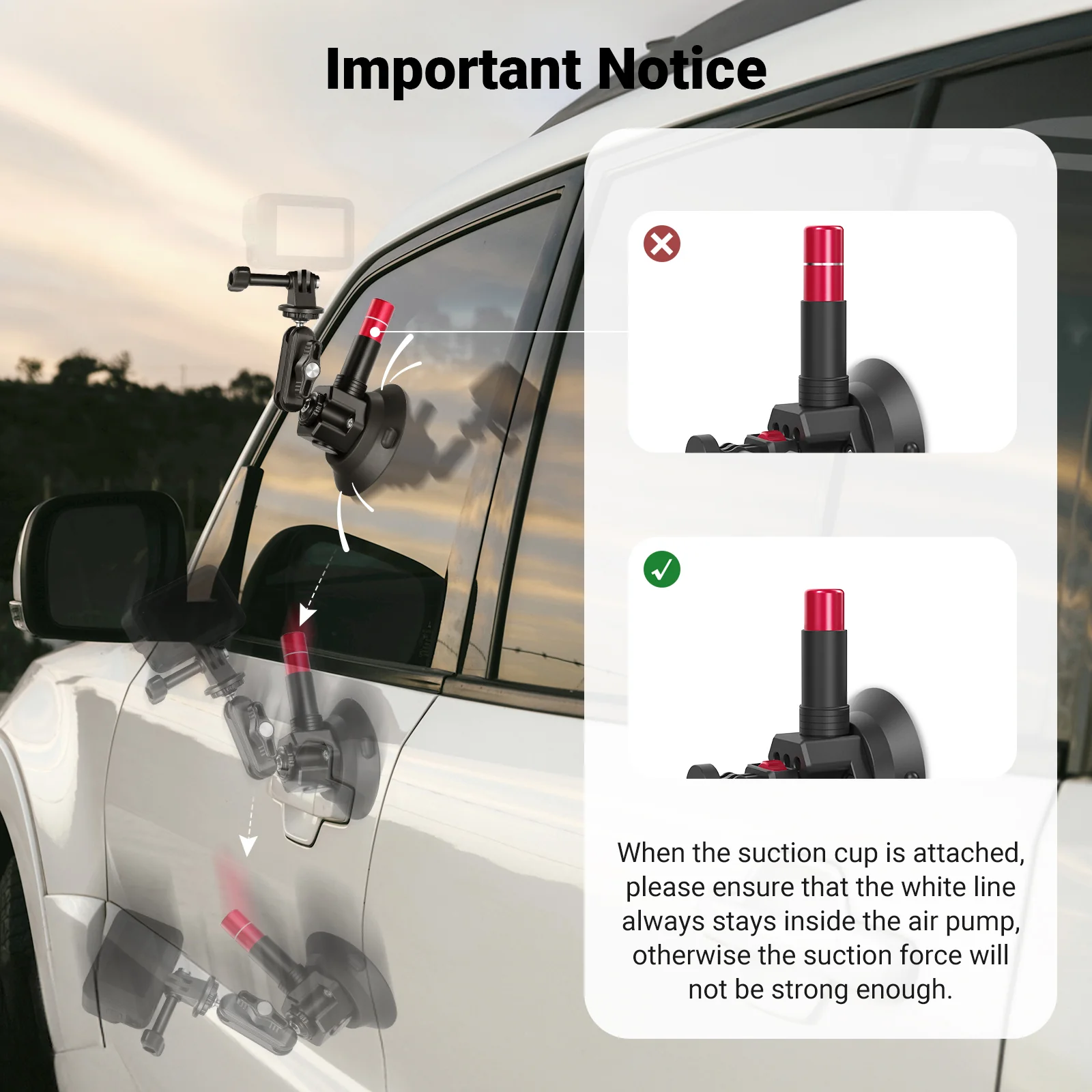
To prevent accidental pressure loss during extended shoots, Neewer integrates visual vacuum check indicators into its pump-actuated mounts (CA136, CA013, CA104, CA105). The manual piston plunger features a white or red safety line painted onto the cylinder body.
Visual vacuum check indicator: when the white line becomes visible, stop and re-pump immediately.
When the plunger is repeatedly depressed, air is evacuated beneath the rubber pad, drawing the plunger inward until the safety line is fully hidden inside the pump housing. If environmental factors—such as thermal contraction, surface micro-cracks, or chassis vibration—cause air to seep under the cup edge, the spring-loaded plunger pushes outward, exposing the colored line. This provides filmmakers with an immediate visual alert to stop the vehicle and re-pump the plunger before the seal degrades completely.
Redundant Containment: Secondary Safety Lanyards
Neewer includes braided wire safety tethers or high-tensile nylon lanyards across its vehicle mounting kits. A safety tether serves as a crucial redundant failsafe. One end of the lanyard is fastened directly to the camera housing or extension pole clamp, while the opposite end is anchored to a structural part of the vehicle, such as a side mirror bracket, roof rack pillar, or door frame gap. In the event that extreme wind shear or surface contamination causes the primary suction cups to lose adhesion, the safety lanyard catches the falling camera equipment, preventing expensive gear loss.
Device Compatibility and Ecosystem Integration
The NEEWAR Car Clamp hardware ecosystem incorporates industry-standard mounting threads, making it versatile across multiple camera platforms:
- Action Camera Ecosystems: All Neewer vehicle kits include a 1/4″-20 female to 3-prong action camera mounting adapter. This provides out-of-the-box support for GoPro Hero 9 through 13 Black, GoPro Max, Insta360 X2/X3/X4, Ace Pro, and DJI Osmo Action 2 through 5 Pro. When mounted on extension poles, 360-degree cameras stitch out the pole profile in post-production, creating floating third-person tracking shots.
- Mirrorless and Compact Cinema Cameras: Using standard 1/4″-20 and 3/8″-16 threads, models like the CA013 and CA105 mount directly to full-frame mirrorless camera cages (such as SmallRig or Neewer cages for Sony A7SIII, FX3, Canon EOS R6, or Panasonic Lumix GH6). When rigging mirrorless cinema setups, filmmakers should attach the camera body directly to low-profile magic arms rather than long extension poles to minimize leverage shake.
- Smartphone Content Creation: Using kits like the CA158 or adding phone clamps to the CA065/CA104 allows creators to mount flagship smartphones (including iPhone 16 Pro Max or Samsung Galaxy S25 Ultra) for interior vlogging, windshield dashcam angles, or exterior rolling footage.
Community Feedback, Real-World Tests, and Market Sentiment
Synthesizing user feedback across B&H Photo, Best Buy, Amazon, YouTube gear channels, and Reddit communities (such as r/Insta360 and r/videography) reveals strong consensus regarding Neewer’s real-world vehicle performance.
Performance Highlights
- High-Speed Reliability: Multiple verified buyers report successful high-speed testing. On B&H Photo, reviewers noted driving at speeds reaching 100 mph (160 km/h) with the CA065 triple mount attached to rear car glass without experiencing seal failure or camera movement.
- Value-to-Performance Ratio: Retailing between $89 and $139 for complete triple-cup extension kits, Neewer provides an accessible entry point compared to high-end industrial rigging systems that often cost several hundred dollars.
- Modular Usability: Content creators on r/Insta360 highlighted the value of modular design, noting that the ability to break down triple-mount kits into standalone single or dual cups enables flexible mounting on windshields, sunroofs, or body panels.
Limitations and Practical Considerations
- Thread Stripping from Over-Tightening: A recurring observation among heavy users involves over-tightening aluminum thumb screws or U-bracket threads. Excessive force applied to wingnuts can strip internal threads. Users are advised to hand-tighten hardware firmly without applying external tools.
- Vibration Sensitivity on Max Extension: Deploying thin aluminum poles out to 43.3 inches at high speeds can introduce high-frequency micro-vibrations. While modern camera stabilization algorithms (GoPro HyperSmooth, Insta360 FlowState, DJI RockSteady) smooth out most movement, carbon fiber models like the CA136 provide superior dampening for critical cinema projects.
Suction Mounts vs. Magnetic Mounts vs. Physical Wheel Clamps
To resolve common search term confusion, it is helpful to categorize automotive “clamps” into their distinct product categories:
| Product Category | Primary Application | Compatible Surfaces | Key Advantage | Main Limitation |
|---|---|---|---|---|
| Neewer Suction Mounts (CA065 / CA136 / CA013) | Camera Mounting & Filming | Glass, Aluminum, Carbon Fiber, Paint | Works on non-magnetic panels; leaves no residue | Requires clean, non-porous flat surface |
| Magnetic Camera Mounts | Camera Mounting & Filming | Steel Body Panels Only | Instant snap-on attachment | Cannot stick to glass, aluminum, or carbon fiber |
| Physical Wheel Lock Clamps (Tevlaphee, VEVOR) | Vehicle Anti-Theft Security | Vehicle Rubber Tires / Wheels | Physical vehicle immobilization | Heavy steel construction; not for camera use |
As shown above, suction mounts adhere to non-porous surfaces including glass windshields, panoramic sunroofs, painted aluminum hoods, and carbon fiber panels. Magnetic camera mounts rely on rare-earth neodymium bases, which cannot stick to glass, aluminum car panels (common on modern trucks and sports cars), or carbon fiber bodywork. Finally, physical tire lock clamps are heavy steel anti-theft security devices; Neewer does not produce tire locks, and queries for “NEEWAR Car Clamp” refer exclusively to camera support hardware.
Installation, Operation, and Maintenance Blueprint
To ensure maximum structural safety, prevent paint damage, and prolong equipment life, creators should follow a standardized preparation and maintenance routine when using any NEEWAR Car Clamp rig.
- Surface Preparation: Thoroughly wash and dry the vehicle body panel or glass surface. Clean both the vehicle surface and the rubber pad of the suction cups using a clean microfiber cloth dampened with isopropyl alcohol to remove wax, road oils, grime, or ceramic coating residues.
- Mounting and Vacuum Engagement: Position the suction cups on flat, clean, non-porous surfaces. Avoid placing suction pads over vinyl wraps, decal edges, panel seams, or sharp sheet metal curves that disrupt the vacuum seal. For lever cups, engage the mechanical lock levers completely. For pump cups, depress the piston plunger repeatedly until the visual white safety line is fully hidden inside the pump housing.
- Rigging and Angle Alignment: Connect extension poles, NATO rails, and magic arm assemblies. Adjust the dual 360-degree ball heads to frame the camera angle. Hand-tighten all locking thumb screws, pipe clamps, and NATO levers firmly. Keep the camera payload’s center of gravity as close to the suction base as possible to minimize leverage forces.
- Secondary Safety Tethering: Thread the included wire safety lanyard through the camera housing or cage. Anchor the opposite end securely to a permanent vehicle fixture, such as a side mirror arm, door pillar frame, or roof rail.
- Pre-Flight Inspection: Perform a physical tug test by pulling firmly on the mounting arm in multiple directions prior to driving. Check the visual indicator lines on pump-actuated models to verify vacuum pressure. During extended shooting schedules or shifting ambient temperatures, inspect the vacuum check lines periodically and re-pump as needed.
- Removal, Cleaning, and Storage: Pull upward on the quick-release rubber tabs at the edge of each cup to break atmospheric vacuum pressure gently. Never use screwdrivers or sharp tools to pry up suction cup edges, as this tears the soft rubber sealing lip. Rinse silicone pads with clean water if dust accumulates, and allow them to air dry completely before storing in a protective case.
The Pros, Cons, and Final Verdict
The Neewer automotive mounting ecosystem delivers a versatile, reliable, and cost-effective camera support platform for automotive journalists, action sports creators, and video bloggers seeking high-production driving footage.
The Pros (Why We Recommend It)
- Outstanding Value: Complete triple-suction kits cost a fraction of high-end cinema mounting systems while delivering high performance.
- Modular Design: Components break down into single or dual-cup configurations, offering adaptability across windshields, sunroofs, and hoods.
- Active Pressure Monitoring: Visual indicator lines on pump models provide clear safety alerts during long shoots.
- Extensive Compatibility: Works natively with GoPro, Insta360, DJI, mirrorless camera cages, and smartphones.
The Cons (Things to Keep in Mind)
- Dynamic Load Limits: Deploying extension poles to maximum length reduces payload capacity down to 2.2 lbs (1 kg).
- Aluminum Thread Care: Thumb screws require careful hand-tightening to avoid stripping threads over long-term use.
- Speed Limit Constraints: Recommended maximum driving speed is capped at 80 km/h (50 mph) for general safety compliance.
Final Verdict: If you are filming with action cameras, 360 gear, or lightweight mirrorless rigs, the NEEWAR Car Clamp lineup offers unmatched performance per dollar. The CA065 remains the best all-around choice for action cam creators needing pole extension flexibility, while the CA136 offers carbon-fiber stiffness for professional setups. For heavy mirrorless rigs mounted close to the vehicle body, the 6-inch CA013 single vacuum mount is the standout solution.
Ready to Capture Cinematic Car Footage?
Upgrade your vehicle camera setup today with Neewer’s reliable automotive mounting systems.
NEEWAR Car Clamp: Frequently Asked Questions (FAQ)
What is a NEEWAR Car Clamp?
How fast can I drive with a Neewer car camera mount?
Will the suction cup mount damage my car paint?
Can I mount a full mirrorless camera on the NEEWAR Car Clamp?
What is the difference between the Neewer CA065 and CA136?
Do I need a safety tether with a vehicle camera mount?
Follow TheKZVerse
Enjoyed this review? Subscribe to our channels and join TheKZVerse community for more tech, gaming, and gear unboxings!
Subscribe to our email newsletter to get the latest posts delivered right to your email.
Comments